Nowadays Water Turbines are used to convert hydraulic energy into mechanical energy.
There are different types of water wheels used according to requirements.
At present, Water Wheels have no more use in practice but as mechanical engineering professionals, we have to have knowledge of this useful invention.
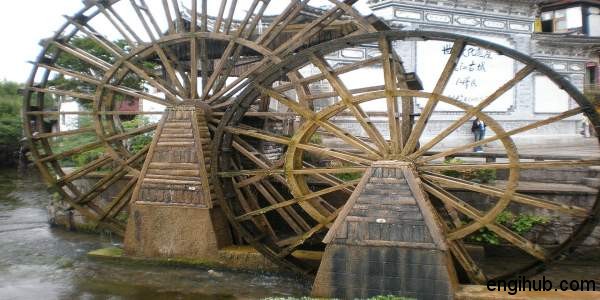
So, In the old days, the following types of Water Wheels had been used
Overshot Water Wheel
Actually, this wheel runs entirely by the weight of the water. But some it may run by the impulse of the water.
The water from the slightly upper position, which is called the headrace, is allowed to enter into buckets through an adjustable sluice gate.
The buckets are forced downwards due to the weight of the water and the water wheels start rotating.
The water-filled buckets get emptied in the lower position, called a tailrace.
To utilize maximum water energy, the buckets are arranged in the proper manner.
Hence the crown of the wheel is made slightly below the headrace.
The water strikes the buckets at some initial velocity. So, the wheel starts rotating partly by an impulse of the water.
Overshot Water Wheel is useful in water heads from 10 to 25 meters.
Hence for such a high head, the diameter of the wheel is from 3 to 20 meters.
We can achieve 60 to 80 percent efficiency from this wheel at 4 to 8 R.P.M. (Rotation per Minute).
The 8 to 10 numbers of buckets are sufficient for its construction.
Breast Water Wheel
In this type of water wheel, the water enters the buckets at the breast height of the wheel.
Hence wheel runs partly by weight and partly by an impulse of the water.
With the help of rock and pinion arrangement, the water from the headrace is entering the buckets without shock through a number of passages.
So, the wheel starts rotating due to the weight of the water and buckets start moving downwards.
Breast Water Wheel had two main special features, first its bottom is immersed in the tailrace of the water, and second the diameter of the wheel is more than the head of water available.
This water wheel is useful in 1 to 5 meters water head, with a diameter of 4 to 8 meters.
The efficiency of this water wheel is 50 to 60 percent at 3 to 7 R.P.M.
Undershot Water Wheel
In this type of water wheel, the water in the form of a jet impinges on the vanes at the bottom of its periphery.
Hence this wheel entirely runs by the impulse of the water.
The jet of the water strikes the vanes and this makes a wheel rotate.
Before water strikes the buckets or vanes of the wheel, the available water head is first converted into a velocity head.
Undershot Water Wheels are useful where the available water head is less than 2 meters.
Hence the diameter of the wheel is 2 to 4 times the water head.
The efficiency of this type of wheel is only 35 to 45 percent at 2 to 4 R.P.M.
Poncelet Water Wheel
In this type of water wheel, curved vanes are used to replace straight vanes. Hence this wheel entirely runs by the impulse of the water.
The vanes are curved at such an angle so that the jet of water enters the vanes without shock.
The water flows down to the tailrace without spillover at the outlet due to its sufficiently long vanes.
The Poncelet Water Wheels is useful in 2 to 3 meters water head.
The diameter of the wheel is 2 to 4 times the water head.
The efficiency is 50 to 65 percent with 2 to 5 R.P.M. The inlet angle of the vane is 15 degrees.
Water wheels are of no use in hydroelectricity generation. Will you like to know, how hydroelectricity is generated?
Read:- Hydroelectric Energy: Complete Information on one form of Clean Energy
Besides this information, you are suggested to read something more from below engineering books