Steam engines are used widely in engineering up to 1930 for the generation of power.
Nowadays it is replaced by an internal combustion engine.
The diesel engine and the petrol engine is the common example of internal combustion engines.
Steam engines are widely used on ships and on railways in old days at present they are replaced by diesel engines.
Hence to disclose some more important information about this old machine steam engine, I am sharing the information about steam engine parts and their functions.
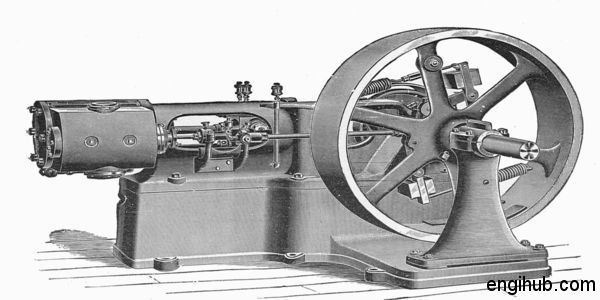
So, Below are the Important Steam Engine Parts
Frame
It is the heavy casting that supports all the stationary and moving parts of the engine and holds them in proper alignment.
This requires the foundation to rest upon or the engine bedplate fixed on the engine foundation.
Cylinder
It is the cast-iron cylindrical hollow vessel in which the piston moves to and fro under the pressure of steam.
The crank side end and an outer end of the cylinder are closed by end covers and made steam-tight.
Steam Chest
It is the closed chamber integral to the cylinder. It supplies steam to the cylinder with the movement of a slide valve.
Stuffing Box and Gland
This part is fitted with the crank end cover of the cylinder.
Its function is to prevent the leakage of steam past the piston rod.
Piston
It is the cast-iron cylindrical disc moving to and fro in the cylinder under the action of the steam pressure.
This part converts the heat energy of steam into mechanical work.
Cast iron piston rings make the piston steam tight in the cylinder and thereby prevent the leakage of steam past the piston.
Crosshead
It is the link between a piston rod and the connecting rod.
It guides the motion of the piston rod and prevents it from bending.
Connecting Rod
This is a cast iron part that helps to convert the reciprocating motion of the piston into the rotary motion of the crank.
A Gudgeon pin is used to connect one end of connecting rod to the crosshead. Its open end is connected to the crankshaft.
Crankshaft
It is made from mild steel on which a flywheel is mounted on it.
It is supported by the main bearings of the engine and it is free to rotate in them.
Slide Valve
This valve is fixed on the steam chest. Its function is to admit the steam from the steam chest to the cylinder.
The slide valve also exhausts the steam from the cylinder at the proper moment.
The valve gets to and fro motion from the eccentric fitted on the crankshaft.
Main Bearings
This part support crankshaft and is fitted in the engine frame known as a main bearing journal.
Flywheel
It is made from cast iron or cast steel.
This is mounted on the crankshaft to prevent the fluctuation of engine speed throughout the stroke.
Hence it carries the crank smoothly over the dead centers.
Governor
To control the speed of the engine according to the load conditions, the governor is used.
The speed of the engine is controlled either by the quantity or pressure of the steam supplied to the engine.
I hope you will get some idea of Steam Engine parts.
Besides this information, you are suggested to read something more from below engineering books
So, Here you find the Best Engineering Resources for further details
To get the more details about the topic, I further recommended reading
- Engineering Thermodynamics
- Basic & Applied Thermodynamics
- A Textbook of Engineering Thermodynamics
- A Textbook of Thermal Engineering: Mechanical Technology
If you like the post, share it with your friends and also on social sites.